• Home
  • Strategic Analysis Reports
  • My work at EDN
  • Folow EEdailynews on Twitter
  • Follow Mike Demler on Twitter
.
  • Home
  • Design
  • EDA
  • EE career
  • Gadgets
  • Mobile/Wireless
  • Semiconductor
You are here : Home »
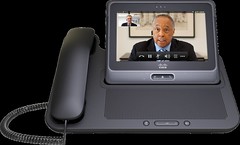
The Android ecosystem expanded in a new direction today at the annual Cisco Live! event in Las Vegas, as Cisco announced a "First-of-its- kind HD Video-Capable Business Tablet" based on the Android operating system.


Cisco Cius business tablet in its docking station
Originally uploaded by Cisco Pics
While Apple has been promoting the iPad for use in the enterprise, the new Cisco Cius leverages the high penetration of Cisco® Unified Communications for business. The company has installed "more than 23 million" of their IP phones at 85% of Fortune 500 companies.  


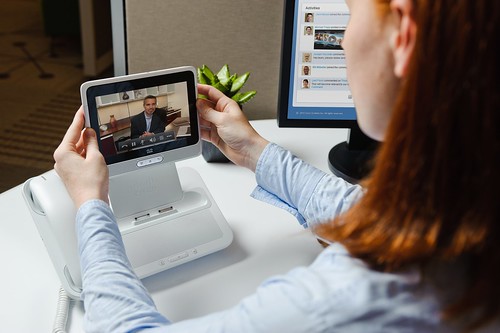
The Cius is smaller than the iPad at 7" versus 9.7", allowing docking with a desktop phone stand. One of the interesting features is that the Cius will employ an Intel Atom 1.6-Ghz processor with 32-GB of flash memory. This is the second big announcement of an Intel-based Android device in a little over a month, following on the announcement of Google TV. 

Also interesting is the list of connectivity modes listed for the Cius: 802.11a/b/g/n Wi-Fi, 3G/4G data and Bluetooth 3. Cisco has been active in WiMAX network development with Clearwire and was recently a sponsor of the 4G WiMAX Symposium at Stanford University.

For application developers, this expansion of Android into the enterprise will provide new opportunities, as an SDK for Cius will be released:
Cisco will help expand Android developed applications for business by offering Cisco Collaboration Application Protocol Interfaces (API's) to developers through a Software Developer's Kit (SDK).

Other interesting features of the Cius:
  • Make a voice or high-definition video call at the desktop or remotely.
  • A front-mounted 720p HD camera which refreshes at up to 30 frames per second
  • 5-megapixel rear facing camera that can transmit streaming VGA quality video and capture still images, and dual noise-cancelling microphones for audio conferencing.
  • Join or initiate an audio, web, or Cisco TelePresence solution conference (not sure why WiFi only, with 4G built-in).
  • Create, edit, and share files and videos.
  • Browse the web with an integrated Firefox browser. (And, I would assume, support for Adobe Flash).
  • Support for cloud computing through desktop virtualization. "The tablet will come standard with a virtual desktop client application, so it can act as a thin client on your Cisco Collaboration Architecture".
At Cisco Live! the Cius was demonstrated for use in an academic setting, and applications were also discussed for other other markets such as retail and medical.  Will we also see a consumer version, migrating the Cius technology to the Cisco Flip brand?

Cisco Cius Mobile Collaboration Business Tablet
"Cisco Cius Mobile Collaboration Business Tablet by Cisco Pics, on Flickr"
According to Chris O'Brien in this morning's edition of the San Jose Mercury News, "We're not ready for the mobile revolution".  In the aftermath of this week's iPhone-4 hysteria, Chris raises a number of important red flags.  It's a good summary of some issues that will impact deployment and adoption of mobile broadband services in the U.S., but I found that some of the points were perhaps overstated while others are a bit more serious than described.  Here are the points raised in the Mercury News article, along with my comments and analysis.
Competition: Or I should say, the lack of it. In late May, the FCC released its annual report on the state of competition in mobile and wireless markets. The news is not good. Consolidation has accelerated to the point that we are all but living in a duopoly controlled by AT&T and Verizon Wireless.At the end of 2009, those two companies controlled 60 percent of the wireless market...

The numbers used for this calculation took into account all cellular subscribers, not just the minority that are currently using 3G data services. When you break down 3G market share, as in the illustration below, you see that in actuality AT&T and Verizon Wireless account for approximately 75% of the market.  I based this data on the most recent numbers reported in Q1, except for Sprint where I had to estimate from other data such as reported ARPU and number of post-paid subscribers. Regardless, the iPhone has definitely been a great benefit to AT&T in the 3G market, as they reported "3G Postpaid Devices" totaled 26.8 million in Q1-2010.  Verizon Wireless reported that 30% of their 92.8M subscribers have 3G devices, equivalent to approximately 15.8 million. With the iPhone-4 introduction coming at the same time as the new DROID-X, it will be interesting to see how this plays out next quarter.


Investment: AT&T and Verizon boasted about the money they are spending on their wireless networks. "We've spent $59 billion on our network since Verizon Wireless was formed, about $5.5 billion a year, every year," said Nicola Palmer, vice president for networks at Verizon. Britton said AT&T has spent almost $55 billion over the past three years.  But according to the FCC report, because the number of subscribers has exploded, this spending has actually fallen as a percentage of revenue, from 20 percent to 14 percent between 2005 and 2008.
I'd like to see this data presented at CTIA Wireless the next time FCC Chairman Genachowski shares the same stage with Ralph de la Vega (President and CEO-AT&T Mobility and Consumer Markets), who is this year's Chairman of the CTIA organization.

Exclusive handset deals: These deals are making the bottleneck worse in two ways. First, all the iPhone traffic gets carried by one company's network, rather than being distributed over several networks. And second, exclusive deals allow carriers to compete on the availability of handsets rather than the quality of service. "If consumers could get an iPad and put it on any network, they would," said Chris Riley, policy counsel at Free Press, a consumer advocacy group. "And it would drive AT&T to invest more."
I don't totally agree on this issue. First, the media often ignore the fact that there is no one wireless communication standard in the U.S. Handsets do not become exclusive purely through business agreements. To be totally portable across any operator network requires support for all the 2G and 3G bands (CDMA/EVDO and GSM/HSPA). This might be doable, but it adds cost.

Second, if the purpose was to roam, say from AT&T to Verizon to fill gaps in coverage, battery consumption (from redundant radio operation) would suffer as well. (Not to mention all the other data network handover issues, which are non-trivial, and associated business issues).

Do consumers really suffer from these exclusive deals?
The iPhone is no longer as dominant as it was at introduction. Companies such as HTC are making multiple versions of their Android phones that provide a very competitive alternative, along with choice of service. The smartphone market is intensely competitive in the U.S., and I would argue that consumers do benefit when the operators and manufacturers need to fight for differentiation. Some may raise the concern for Android "fragmentation", but look how much innovation has occurred in just a little more than a year and a half since the G-1 was introduced!

Spectrum: Here's one that everyone does agree on. "We have been suggesting that there is a crisis brewing and there needs to be a focus on bringing spectrum to the market," said Chris Guttman-McCabe, vice president of regulatory affairs for CTIA-The Wireless Association.
Well, maybe not everybody. Of course CTIA wants as much spectrum as they can get their hands on for their members. It's a critical resource. But, is the issue really more spectrum or better coverage? Once again, it is the iPhone problem on AT&T's network that everyone seems to focus on.

As I pointed out in my report on The Emerging 4G Wireless Landscape in the U.S. the generalization does not hold true for all the operators. Sprint and Clearwire hold a significant advantage with the capacity of their 2.5GHz WiMAX spectrum licenses.

In the press release for my 4G report I stated that the "Explosive Growth in Mobile Video Shifts Advantage to WiMAX Providers Until 2012". I stand by that prediction today. With Verizon and AT&T accounting for 75% of the current 3G market, it should come as no surprise that the "spectrum crisis" gets as much attention as it does. Sprint, which has been trailing badly in 3rd position, has a real lead in deploying 4G technology. Regardless of arguments of what is really 4G in terms of speed, the capacity advantage is clear (no pun intended) and quantifiable.

More is always better when it comes to spectrum, but inevitably we do need to look at how we use what we have more efficiently. Conservation is also good. See my report on Next-Generation ICs for Mobile Devices - Innovations in Wireless Design for a glimpse at how future cell phones may take advantage of software-defined (SDR) and cognitive radios.

The 4G WiMAX Developer's Symposium at Stanford on June 15th provided a full day of presentations on Clearwire/Sprint's growing 4G network, including demonstrations from several startups on how they intend to exploit the increased mobile broadband capacity, followed by a review of ongoing trends and visions of future developments. For the full agenda, see my earlier post.

The opening keynotes were:

10:30 – 11:00am Keynote: 4G Growth & Momentum Terese Elder: Clearwire President of Wholesale
11:00 – 11:30am Keynote: Exciting Times in BB wireless Bob Azzi: Sprint Senior Vice President, Network

In her presentation, Clearwire's Terese Elder covered the current status of the WiMAX service (covering 34 markets today), while reiterating the target for 120M pops by the end of 2010. 

She also cited a number of statistics from Morgan Stanley:
  • Projected 10B mobile devices 2010-2020.
  • More than just phones, there will be 10X more mobile connected devices than fixed.
  • Mobile users will exceed desktop in 5 yrs.
  • Smartphones will out ship notebooks + netbooks 2010, and global PC market in 2012.
  • Market opportunity: 36% growth in mobile broadband subscribers, 24% growth in revenue ($3B-$10B) (2014) 

Her comment that "it will be interesting to see what happens with VOIP, Skype" is noteworthy. While voice revenues are declining, the future LTE operators continue to debate how to integrate voice and data in their 4G plans.

Will voice continue to be treated as a separate service (at an additional fee), or will the voice bits be bundled along with the rest of 4G data in an all-IP network? Clearwire  supported the Skype app previously on the Samsung Mondi, the 1st WiMAX MID which was introduced last year.  According to Ms. Elder, "Skype has more registered users than any carrier in the world".

Looking beyond VOIP and video, this was her list of "killer" 4G apps:
  • cloud computing goes mobile.
  • users spending more time on social networking than email
  • business content for the enterprise
In his presentation Bob Azzi, Senior VP Networks at Sprint, picked up on the plans for WiMAX rollout, stating that "San Francisco and San Jose are on the list for 2010". Clearwire's Silicon Valley WiMAX Innovation Network currently includes base stations on the Stanford campus in Palo Alto, at Intel in Santa Clara, and at Google in Mountain View.

While pointing to the recent introduction of the HTC EVO, Mr. Azzi gave his description of the "4G experience" and how subscribers are making use of WiMAX:
  • 2-way video conferencing (QIK)
  • unified communications
  • WiFi enablement (i.e. the hotspot feature of the EVO, and the Sprint Overdrive)
  • network redundancy for landlines
  • media content adds hidef, full length video
  • live video surveillance
  • simultaneous app viewing
Sprint's Azzi also reviewed the advantages offered by Clearwire's spectrum position (120-150 MHz at 2.5GHz), comparing it to the 12-46 MHz of 700 MHz and AWS spectrum that competitors such as Verizon Wireless will deploy for LTE. This is a topic I covered thoroughly last year in my report on "The Emerging 4G Wireless Landscape in the U.S.".

In order to make his point regarding the spectrum-capacity advantage, Mr. Azzi showed a chart something like the one I have reproduced above.  This graph is based on a claimed capacity for Sprint 4G of 420Mbps per tower, compared to an LTE competitor's (read Verizon Wireless LTE here) of 100 Mbps per tower.


This chart is somewhat deceptive, since Clearwire currently deploys their WiMAX spectrum in three 10MHz sectors per tower. With less spectrum for LTE, Verizon is expected to deploy one sector per tower (paired: 10 MHz uplink, and 10 MHz downlink). When asked, Mr. Azzi said this difference is based on deploying all 150 MHz of capacity at each tower (which is not likely).

If we break down the numbers then,we should divide the Clearwire Mbps/user by a factor of 5. The result is that the projected speeds that users can expect from Clearwire and Verizon are just about identical. This is much more in line with actual reported results.

One more caveat though: this only applies to the downlink. Clearwire is currently capping the upload date rate to 1Mbps. As I have reported in the past, this is an issue with the promotion of video conferencing as a "killer app" for WiMAX. In upload, Verizon's LTE has a potential advantage due to the FDD vs. TDD nature of the spectrum resource. In response to my question after his presentation, Mr. Azzi said they are continuing to watch this, but any adjustment will require trading off download for upload speed. 


In video conferencing the lower resolution 1.3Mpixel front-side camera of the HTC EVO does produce much less of a load on the network than the 8 Mpixel back-side camera, but upload streaming apps could definitely suffer. This is also exactly why the (over-hyped ) iPhone 4 "FaceTime" app will be WiFi only.

Finally, in regards to the spectrum comparison, Mr. Azzi also pointed out that they have 800Mhz and 1900 Mhz spectrum that can be re-deployed in the future. For enhancing coverage, he also made the statement that Sprint will "evolve femto cells from 3G to 4G".

-Mike

Follow me on Twitter: MikeDemler


View Mike Demler's profile on LinkedIn
I am looking forward to attending the 4G WiMAX Symposium at Stanford University tomorrow. As you can see from the agenda below, Clearwire and their investors (Sprint, Intel, Comcast, Time Warner Cable) will be well represented. This looks to be an interesting follow up to the Clear 4G Innovation Network Workshop held earlier this year at the Santa Clara Convention Center.

Look for my follow up report in the next few days.

Stanford Center for Professional Development
4-G WiMAX Developers Symposium
Event Agenda 4-G WiMAX Developers Symposium
9:00 – 10:00am Check-in & Coffee
10:10 – 10:25am Event Kick Off Curt Frank: Stanford University School of Engineering Senior Associate Dean
10:30 – 11:00am Keynote: 4G Growth & Momentum Teresa Elder: Clearwire President of Wholesale
11:00 – 11:30am Keynote: Exciting Times in BB wireless Bob Azzi: Sprint Senior Vice President, Network
11:40- 12:25 New Developments in 4G Dow Draper: Clearwire VP Product Development and Innovation
Nathan Smith: Sprint Application Developer Program Manager
Lunch
1:00 – 2:45pm Application Showcases & Quick Pitches Featuring Demonstrations from: Stanford Univ., Carnegie Mellon Univ., Whatamap, QIK, Mobi, Moog, Livecast, News360, MS Futures Group, Mingleverse, Jim Baker Moderator: 
Guru Parulkar, Stanford University Consulting Professor in Electrical Engineering  
Panel: 
Lisa Garza, Cisco, Service Provider Marketing 
Brian Mullen, Clearwire, Business Development 
Evan Koch, Comcast, Business Development 
Brian Coughlin, TW Cable, Wireless Platform
3:00 – 3:40pm Marketing and Distribution for 4G Apps Dow Draper: Clearwire, VP Product Development and Innovation
Nathan Smith: Sprint, Application Developer Program Director
Russ Beutler: Intel, Atom Developer Program
3:50 - 4:20pm Mobile BB: Vision of the Future Dr. Paulraj Arogyaswami: Stanford University Professor of Electrical Engineering, Emeritus
4:30– 4:55pm Mobile Internet Trends Simon Aspinall, Cisco Senior Director, Service Provider Marketing
5:00pm Closing remarks & reception


Stop me if you've heard this one before...

On June 10, 2010 Synopsys Inc. announced their intent to acquire Virage Logic Corporation, a provider of compilers for embedded memory IP. The acquisition comes a little less than one month after Cadence announced their acquisition of Denali Software Inc. - a provider of memory models and verification IP.  It seems that the respective M&A teams are saving money by sharing calculators.
  • Purchase price for Virage Logic: $315 M. Last year's revenue = $47.4 M
  • Purchase price for Denali Software Inc.: $315 M. Estimated annual revenue = $43 M
Those similarities aside, I don't expect this latest acquisition to be quite as controversial as the Cadence-Denali purchase. Virage is more a semiconductor company than an EDA company, and is much less visible to the DAC partying crowd, many of whom bemoaned the loss of the independent Denali.  This is interesting in a different way since Synopsys is purchasing one of their customers, which leads to a bit of "closing the circle" irony.

Virage was a key early customer and partner in the development of Nassda Corporation, whose HSIM product was specifically architected to increase simulation efficiency by exploiting redundancy (i.e. multiple copies of the same circuit) - a perfect match for memory blocks. The CEOs of the two companies sat on each other's board of directors; Sang Wang at Virage and Adam Kablanian at Nassda. Nassda quickly became very successful in dominating the memory market, enabling the company to complete an IPO in December 2001, just two and a half years after first licensing the software.

The success of Nassda, whose founders had come from Synopsys, led the latter company to pursue a lengthy and bitter lawsuit wherein they accused Nassda of launching the company through misappropriation of trade secrets. After several years of battling the lawsuit, Nassda gave up the fight and agreed to be purchased by Synopsys in December, 2004.

So here we are just about ten years after Nassda began, both tool provider and key customer now acquired by Synopsys.  Startup.. innovate.. get acquired. (Try to avoid being sued).

That's the real EDA-360.

Since I ran a poll on Cadence's purchase of Denali, it's only fair to do the same this time around. To express your opinion on the Synopsys-Virage acquisition, click here.
    Today ATT announced the end of their $30 unlimited data plan, a major factor that drove adoption of the iPhone. (But with the unintended consequence of overloading their network).
    ATT Announces New Lower-Priced Wireless Data Plans to Make Mobile Internet More Affordable to More People
    Here's how the new plan breaks down:
    • For $15 per month consumers can get up to 200 megabytes (MB) of data per month.
    • If you have this "DataPlus" plan and exceed 200 MB in a month, you will be automatically charged an additional $15 for another 200 MB.
    • ATT claims that "Currently, 65 percent of ATT smartphone customers use less than 200 MB of data per month on average".
    • For $25 per month, you can buy up to 2 gigabytes (GB) of data per month.
    • If you subscribe to this "DataPro" plan and exceed the 2 GB limit, you will automatically be charged an additional $10 another 1 GB of data.


    Earlier this year, Consumer Reports commissioned a study of iPhone users that was conducted by the Validas (see the histogram above). According to the Validas study of more than 1,000 iPhone users, the average data consumption is 273 MBs per month.

    Do the math. What will this cost the average iPhone user under the new ATT data plan? Yup.. $30!  So how many customers do you think will go for this new "DataPlus" plan?

    On the other hand, you can subscribe to the "DataPro" plan for $25, a $5 per month saving over the current unlimited plan. Validas found that
    "another 12 percent of iPhone users use at least 500 MBs per month".
    My bet is that the vast majority of iPhone customers will go for the 2GB plan.

    But what about the new 4th (c'mon.. it's not 4G wireless) generation iPhone expected to be announced at next week's Apple Worldwide Developers Conference? According to the now infamous Redwood City bar room lost & found incident, it will include a front-side camera for video chat, like the HTC EVO 4G. The big difference here is that the EVO can take advantage of the Clearwire-Sprint WiMAX network, and an unlimited data plan.  Then there's the iPad, which is intended primarily as a media consumption device.


    In my report on The Emerging 4G Wireless Landscape, I analyzed the impact that mobile video will have in driving adoption of 4G WiMAX and LTE services. At the CTIA Wireless more than one year ago, Motorola showed the set of projected 2011 mobile user profiles in the slide above.  As you can see, it doesn't take much to exceed 2GB per month.

    I think that this latest move by AT&T will serve to further drive users to Verizon, Sprint, and T-Mobile. Android smartphones already exceed the capabilities of even the forthcoming next-generation iPhone. Sprint will continue their WiMAX rollout, Verizon will begin LTE deployment, and T-Mobile will expand on HSPA+.

    Do you think it's a coincidence that ATT's new plan goes into effect on June 7, 2010.. the exact same day as the opening of Apple's Developer Conference?   Who says that less is more?

    Home

    Subscribe to the EE Daily newsletter

    About Us

    My Photo
    Mike Demler
    The EE Daily News is published by Mike Demler. Contact Mike at mike.demler@EEdailynews.com
    View my complete profile


    Advertisement .

    Recent Tweets

    Article Archive

    Archived Publications

    • My work at EDN
    • Industry Publications
    • Strategic Analysis Reports
    .
    © EE Daily News. All rights reserved.
    Designed by SimplexDesign